
November 3, 2026 · 4 min read
Remodeling Spending Just Fell 13 Percent: What That Means for New England's Old Houses
Census data released November 2 shows home improvement spending down 13 percent in a month. New England owns the oldest housing stock in America.
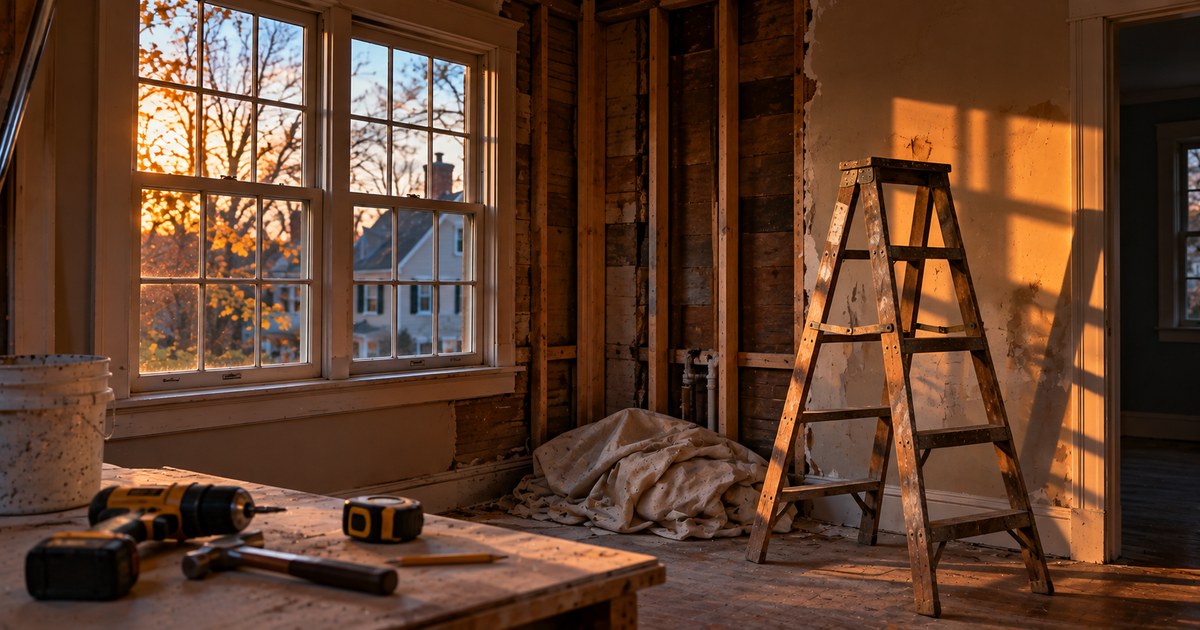
The Census Bureau released September construction spending on Monday, November 2, and the headline hid the real story. Total construction spending fell 1.9 percent for the month and 2.7 percent from a year earlier. Private residential construction fell 5.5 percent to a seasonally adjusted annual rate of $848.8 billion, down 8.9 percent over the year. But new building was not what dropped. In NAHB's reading of the Census figures, single-family spending was unchanged from August and multifamily was essentially flat. The entire decline came from one line: residential improvements, down 13.0 percent in a single month and down 18.0 percent over the year. Americans did not stop building houses in September. They stopped fixing the ones they already own.
The reason is not mysterious. Most renovation work is financed, and the cost of that financing has moved. Freddie Mac's survey put the 30-year fixed at 7.24 percent as of October 29, down from 7.32 percent the week before but well above the 6.17 percent of a year ago. Home equity lines and cash-out refinances price off the same environment, so a project that penciled out last fall does not pencil out now. As an illustrative calculation, $50,000 of work added to a 30-year loan at 7.24 percent costs roughly $341 a month, about $122,700 over the full term. That is the math a homeowner runs at the kitchen table before deciding the bathroom can wait another year.
New England is where that decision compounds, because this region holds the oldest housing stock in the country. NAHB's analysis of American Community Survey data put the median age of owner-occupied homes at 62 years in New York, 58 years in Rhode Island and 57 years in Massachusetts, against a national median of 40 years. A national pullback in improvement spending is an abstraction in a market built in 2005. In a market built in 1955, it is a roof that goes another winter, a boiler kept one more heating season, knob and tube left in a wall. Deferred maintenance does not disappear when spending falls. It accumulates, and it transfers to whoever buys the house next.
So read it as a pricing fact, not a news item. If you are buying in Rhode Island, Massachusetts or Connecticut this winter, treat the inspection report as a capital plan rather than a pass or fail: ask the inspector for the remaining service life on the roof, the heating system, the electrical panel and the water heater, then price those replacements into your offer at today's labor costs, not at what the seller paid a decade ago. If you are selling, understand that buyers are doing exactly that arithmetic, and a dated kitchen is rarely what kills a deal. The furnace is. Getting a mechanical issue documented and quoted before you list lets you set the price, which is a better outcome than having a buyer's inspector set it for you in week three.
Frequently asked questions
Why did home improvement spending drop so much in September 2026?
Census Bureau data released November 2, 2026 showed residential improvement spending down 13.0 percent for the month and 18.0 percent year over year, while single-family and multifamily construction were roughly unchanged. The most direct explanation is financing cost. Freddie Mac's 30-year fixed averaged 7.24 percent on October 29, 2026 against 6.17 percent a year earlier, and home equity borrowing prices off the same environment, so homeowners are deferring projects rather than borrowing for them.
Does a renovation pullback mean home prices will fall?
Not by itself. Improvement spending measures what owners invest in homes they are keeping, not what buyers pay for homes that sell. What it does change is condition. A market where fewer owners are replacing roofs and heating systems sends more houses to market with work pending, which shows up as negotiation on condition rather than as a drop in list prices.
What should a New England buyer budget for an older home?
Ask for remaining service life on every major system at inspection and get current local quotes for anything near the end of it. The median owner-occupied home in Rhode Island and Massachusetts is roughly 57 to 58 years old, so a house at the median is at or past the point where a roof, a boiler and a panel have each come due once already. Budget from the actual age and condition of the systems in front of you, not from a rule of thumb.