
October 16, 2026 · 5 min read
Why New Construction Is Not Getting Cheaper: Builder Labor Shortages Are Rising Again
Builders reporting trade labor shortages rose to 47% from 42%, and labor costs climbed 4.2%. What that means for new construction buyers in New England.
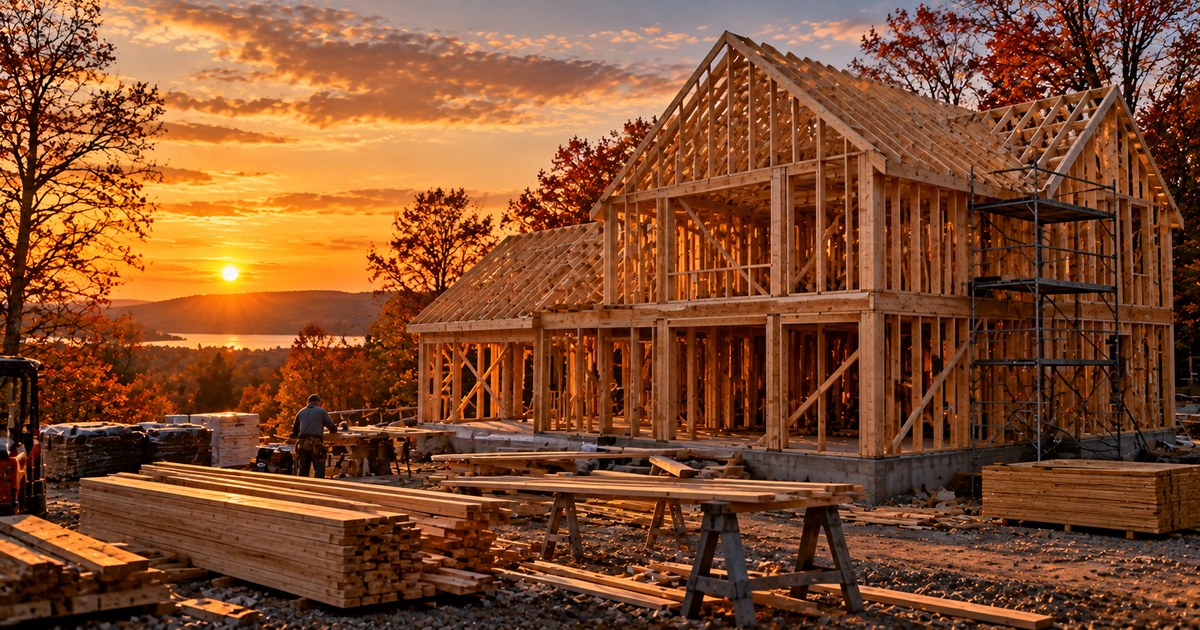
Buyers touring a new construction site this fall tend to ask the same question. If demand has cooled and the 30-year fixed is sitting at 7.40%, why has the base price not come down? Part of the answer turned up in the latest NAHB/Wells Fargo Housing Market Index special questions. In the September 2026 survey, the share of builders reporting a shortage of labor they employ directly ranged from 33% for excavators to 58% for finished carpentry. Averaged across the nine trades NAHB has tracked the same way since 1996, 47% of builders reported a shortage, up from 42% in April 2025. Framing crews moved the most, up 9 percentage points to 57%, with landscaping workers up 7 points to 39% and roofers up 6 points to 36%.
Fewer homes going up, and still not enough hands
The comparison is what makes the number worth your attention. At 47%, the shortage reading is now higher than at any point in the 2004 to 2006 boom, when housing starts ran consistently above 1.8 million a year. August 2026 single-family starts came in at a seasonally adjusted annual rate of 918,000, up 7.6% from July, and total starts stayed under 1.3 million. Builders are putting up far fewer homes than they did twenty years ago and still cannot staff the jobs. Shortages of subcontractors now track direct labor almost exactly, and more than half of builders report shortages of both in the same five trades: framers, rough and finished carpenters, bricklayers, and concrete workers. That matters more than it sounds, because NAHB research found builders subcontract roughly 84% of total construction costs on a single-family home and use about two dozen different subcontractors to finish one.
What it does to your price and your timeline
Builders in the same survey reported a median labor cost increase of 4.2% for the same home over the previous twelve months. When the cost of building does not fall, a builder facing soft demand has two levers, and base price is the one they protect hardest, because cutting it resets the comparable sales for every home still unsold in the subdivision. So the discount usually arrives as an incentive instead: a rate buydown, closing costs covered, an appliance package, a finished basement. Those are real money and worth asking for directly. For context on why the buydown is the one buyers chase, a $400,000 loan at 7.40% over 30 years carries principal and interest of roughly $2,769 a month. That is an illustrative calculation, not a quoted figure, and your own number depends on your rate, your loan size, taxes, and insurance. The second effect of thin trade crews is schedule risk, and in New England a framing or roofing crew that slips three weeks in October is a crew finishing in weather that slows everything behind it.
What to do with this if you are buying new in New England
Three things. Ask the builder who is actually doing the work and when those trades are scheduled, because a contract with a firm delivery date from a builder whose framers are booked into next spring is a date with an asterisk. Build cushion into your rate lock rather than locking to an optimistic closing date, and ask your lender what an extension costs in writing before you need one. And hire your own inspector even though the home is brand new, including a pre-drywall inspection if the schedule allows it, because crews stretched across more jobs than they can comfortably carry is exactly the condition under which small framing, flashing, and mechanical defects get buried behind finished walls. New construction is not a reason to skip an inspection. This year it is a reason to insist on one.
Frequently asked questions
Are new construction prices going to drop in 2027?
Nobody can tell you that honestly. What the September 2026 data shows is that the cost side is not cooperating: trade shortages rose, and builders reported a median 4.2% labor cost increase over twelve months. Falling base prices usually require either demand to drop further or input costs to fall, and right now only one of those is pointing the right way.
Is it better to buy new construction or an existing home right now?
It depends on what you are optimizing for. New construction more often comes with builder incentives, including rate buydowns that can beat anything a resale seller offers, and you get current code and new systems. Existing homes give you a known timeline, a known neighborhood, and a seller who may be more flexible on price. Run both against your real monthly budget rather than your maximum pre-approval.
Why are labor shortages worse now than during the mid 2000s boom?
Residential construction is competing for the same workers as other construction segments, with data center work drawing crews away, and residential construction employment has been trending down. NAHB also notes that immigration enforcement is heightening worker fears and adding to the shortage. The result is a higher shortage reading at under 1.3 million annual starts than the industry had at over 1.8 million.
Should I still get a home inspection on a brand new house?
Yes. A builder's warranty covers you after the fact, but an inspection catches problems before you own them, and a pre-drywall inspection catches the ones that become invisible later. With crews spread thin across more jobs, this is a poor year to rely on the final walk-through alone.
Sources: NAHB/Wells Fargo Housing Market Index September 2026 special questions, U.S. Census Bureau New Residential Construction, and the Freddie Mac Primary Mortgage Market Survey for the week of October 15, 2026.